

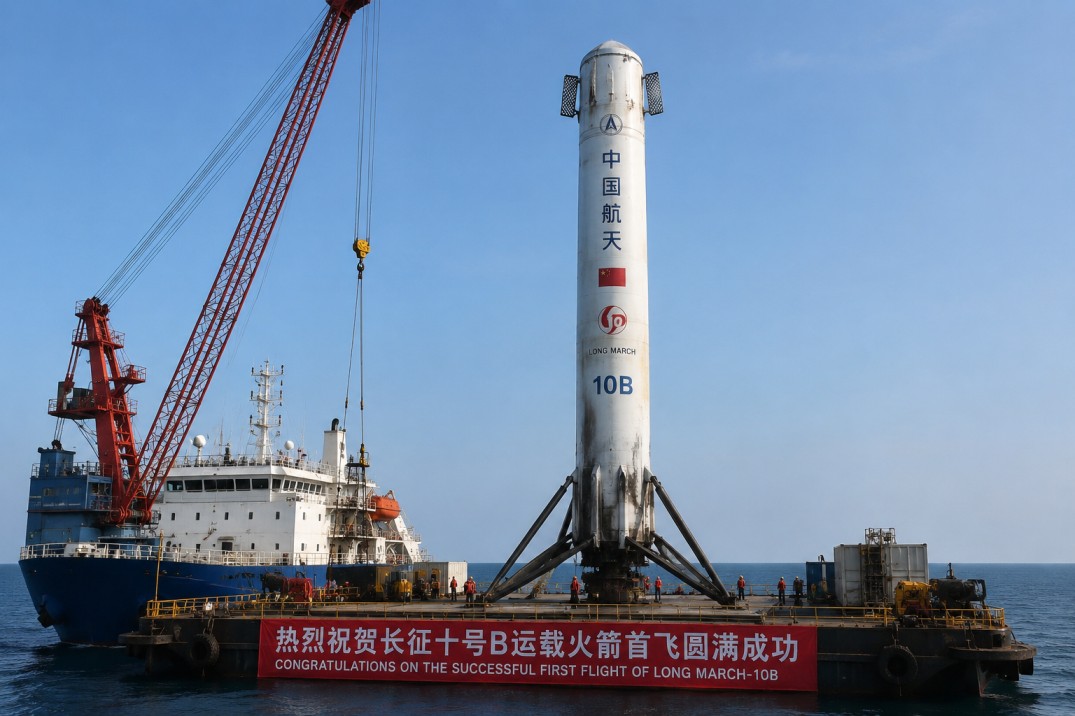
China has reached a significant milestone in its space exploration endeavors by successfully recovering the Long March 10B rocket after its inaugural orbital mission. This achievement positions China as the second country, following the United States, to effectively demonstrate reusable orbital rocket technology, showcasing advancements in its space launch capabilities.
The Long March 10B rocket, standing at 63.6 meters tall, launched from the Hainan International Commercial Aerospace Launch Center. It was propelled by seven engines fueled by liquid oxygen and kerosene. After the separation of the stages, the mission continued with the second stage, which used a liquid oxygen-methane engine to successfully deploy a satellite into its target orbit.
This mission also marked a breakthrough on a global scale, as it was the first instance of an orbital-class rocket recovery using a wire arrestment system. This marks a noteworthy development in the field of reusable launch technology and signifies China’s ongoing expansion of its space program.
The successful recovery of the Long March 10B underscores China’s growing capabilities and ambitions in the space sector, where reusable rocket technology plays a crucial role in reducing costs and increasing the sustainability of space missions. As China continues to push the boundaries of space exploration, this achievement highlights its commitment to advancing its position as a major player on the international stage.