

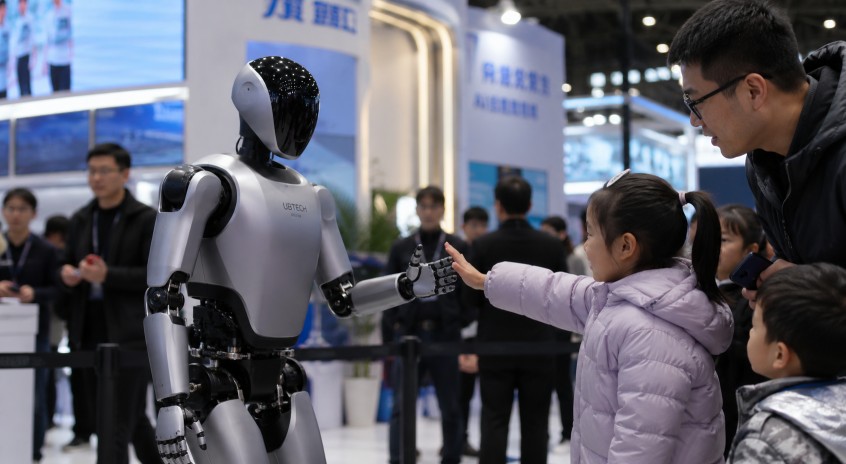
China’s robotics industry has experienced a significant evolution over the last 20 years, transforming from basic remote-controlled gadgets into sophisticated systems with autonomous capabilities. This journey commenced in 2007 with the introduction of the i-Sobot, a compact robot originating from Dongguan in Guangdong Province. Despite its size, the i-Sobot could execute approximately 240 movements, including walking and climbing, marking a notable early achievement in China’s development of intelligent robotics.
What initially started as an experimental project has burgeoned into a flourishing industry. Today’s Chinese robots are equipped with artificial intelligence, granting them the ability to perceive environments, make autonomous decisions, and collaborate with humans across various settings. This advancement has enabled these intelligent machines to step out of research labs and into practical roles in sectors such as manufacturing, logistics, healthcare, and public services, as well as in everyday life.
The increasing deployment of these robots is a reflection of China’s strategic push towards fostering “new quality productive forces,” an economic initiative aimed at technological advancement, increased productivity, and superior industrial development. As these capabilities expand, they are becoming crucial to China’s objective of integrating intelligent automation throughout industries.
The swift development of China’s robotics sector underscores the nation’s growing investment in cutting-edge technologies and its aspiration to embed intelligent automation into daily life and future economic expansion. This progress positions robots not only as indispensable tools in various industries but also as a key component in China’s economic strategy moving forward.