

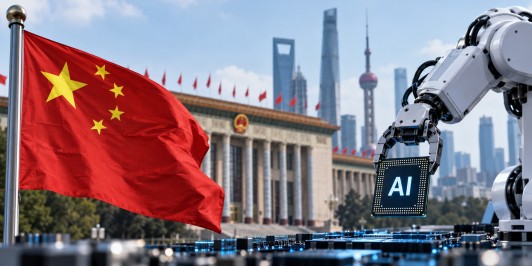
China has dismissed calls to limit its artificial intelligence industry, labeling these efforts as driven by fear and cautioning that such confrontational approaches could hinder global collaboration on AI technology. The rejection follows concerns raised in the United States about China’s swift advancements in artificial intelligence, with critics suggesting that China taking the lead in advanced AI could pose significant security and geopolitical risks.
The Chinese Foreign Ministry has advocated for international cooperation on AI development and governance, warning that rivalry and aggressive competition could disrupt the establishment of global AI regulations. Although China denies that its AI progress presents an inherent threat, Chinese officials have acknowledged the rapid development of increasingly sophisticated AI systems with apprehension.
China’s leadership has underscored the importance of maintaining human control over artificial intelligence, while Chinese security officials have expressed apprehensions that AI could be exploited for large-scale information dissemination, propaganda, and cyber operations, potentially impacting national and political security. Concerns have been particularly raised regarding the misuse of advanced AI models, which could introduce new challenges to cybersecurity and information security.
The discussion underscores escalating tensions between the United States and China regarding leadership in artificial intelligence. Both nations are heavily investing in cutting-edge AI systems and implementing measures to safeguard national security and sustain technological superiority. This disagreement also mirrors a broader global discourse on how governments should regulate increasingly capable AI systems, with some experts and industry leaders advocating for stronger safeguards and international cooperation, while others caution that overly stringent restrictions might stifle innovation and heighten geopolitical divides.
U.S. and Chinese leaders are anticipated to address AI governance and other technology-related matters in a forthcoming meeting scheduled for later this month. Meanwhile, China’s state media has criticized suggestions to slow AI development, arguing that initiatives aimed at restraining China’s technological progress could be part of a larger strategy to curtail the nation’s rise in the global tech sector.