

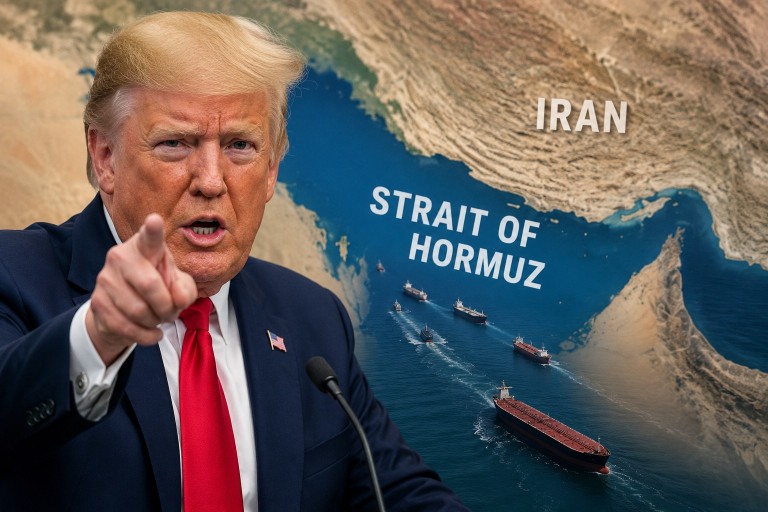
In a bold move, US President Donald Trump has announced plans to declare the Strait of Hormuz as “a territory of the United States,” amid ongoing tensions with Iran. Speaking from New York on Friday, Trump indicated that this declaration would follow an anticipated victory over Iran, asserting that the US already exercises control over this crucial maritime passage through a blockade.
The Strait of Hormuz serves as a vital conduit for global energy supply, with approximately 20% of the world’s seaborne oil exports traditionally transiting this route. The strategic waterway, positioned between Iran and Oman, has seen limited activity since the onset of military operations by the US and Israel against Iran. Trump’s remarks have sparked uncertainty about whether this signifies a shift in US policy or is merely a rhetorical maneuver.
Iran has swiftly dismissed Trump’s threat, with Deputy Foreign Minister Kazem Gharibabadi affirming that Tehran will not succumb to US pressure. He emphasized that decisions regarding the strait’s status remain under Iranian jurisdiction. Meanwhile, Iranian Foreign Minister Abbas Araqchi clarified that Iran has not committed to resuming dialogue with Washington, noting that messages conveyed through Qatar and Pakistan do not equate to formal negotiations.
Tehran has laid out specific preconditions for reopening the waterway to shipping traffic, demanding reparations for conflict-related damages, the lifting of sanctions, and the release of frozen Iranian funds. The ongoing conflict and resultant shipping disruptions have led to a surge in fuel prices, impacting consumers worldwide. Trump defended these increased costs, asserting that they are a necessary measure to prevent Iran from acquiring nuclear capabilities.
The impasse over the Strait of Hormuz continues to stir apprehension regarding the stability of global energy resources and the broader economic ramifications. As the situation unfolds, the international community remains watchful of the potential for escalation and further economic strain.